Co-Founder & CEO

Verra has assessed our stocking index data against the requirements of its ARR methodology. Kanop is now one of three vetted Data Service Providers for VM0047, and the only company independently vetted across all three registries that run formal processes for nature-based data providers.
Verra has announced the first Data Service Providers vetted to supply stocking index data for performance benchmarks under VM0047, its Afforestation, Reforestation and Revegetation methodology. Kanop is one of three organisations on the initial list.
This matters for a specific reason. VM0047 made satellite data a direct determinant of credit volume rather than a supporting exhibit. The stocking index sets the dynamic baseline, the dynamic baseline sets the performance benchmark, and the performance benchmark sets the deduction applied to a project's measured removals. Until now, developers had no independent signal about whether a given data product would hold up against the methodology's requirements. They found out at validation, which is the most expensive possible moment to find out.
Verra's vetting moves that assessment earlier, and we think that is the more important consequence of the announcement than the credential itself.
Verra published the minimum requirements a stocking index data product has to meet. They are worth reading in full if you are choosing a provider, because they are specific and they are not trivially satisfied.
The dataset must have a final spatial resolution of 30 metres or finer for every year provided. It must be available at least annually across the relevant baseline and monitoring years. Optical imagery has to be constrained to a consistent seasonal window each year, so that phenology and atmospheric effects do not masquerade as vegetation change. The provider has to show evidence that its index correlates with aboveground biomass in the specific forest types and ecoregions where it operates, and has to explain how it will demonstrate that correlation project by project at validation.
There is also a set of service commitments, which we would argue are the part developers should care most about. A vetted provider commits to delivering the stocking index datasets, the project and control plot inputs, and the underlying methodological logic and process documentation on request from the project proponent, from Verra, or from a VVB. Where reviewing code is necessary, the provider commits to enabling third-party assessment in good faith. Everything has to arrive in auditable formats, and material changes to how the index is generated have to be reported back to Verra.
That last cluster is the difference between a data feed and an evidence base. A number nobody can interrogate is not much use in a verification process.
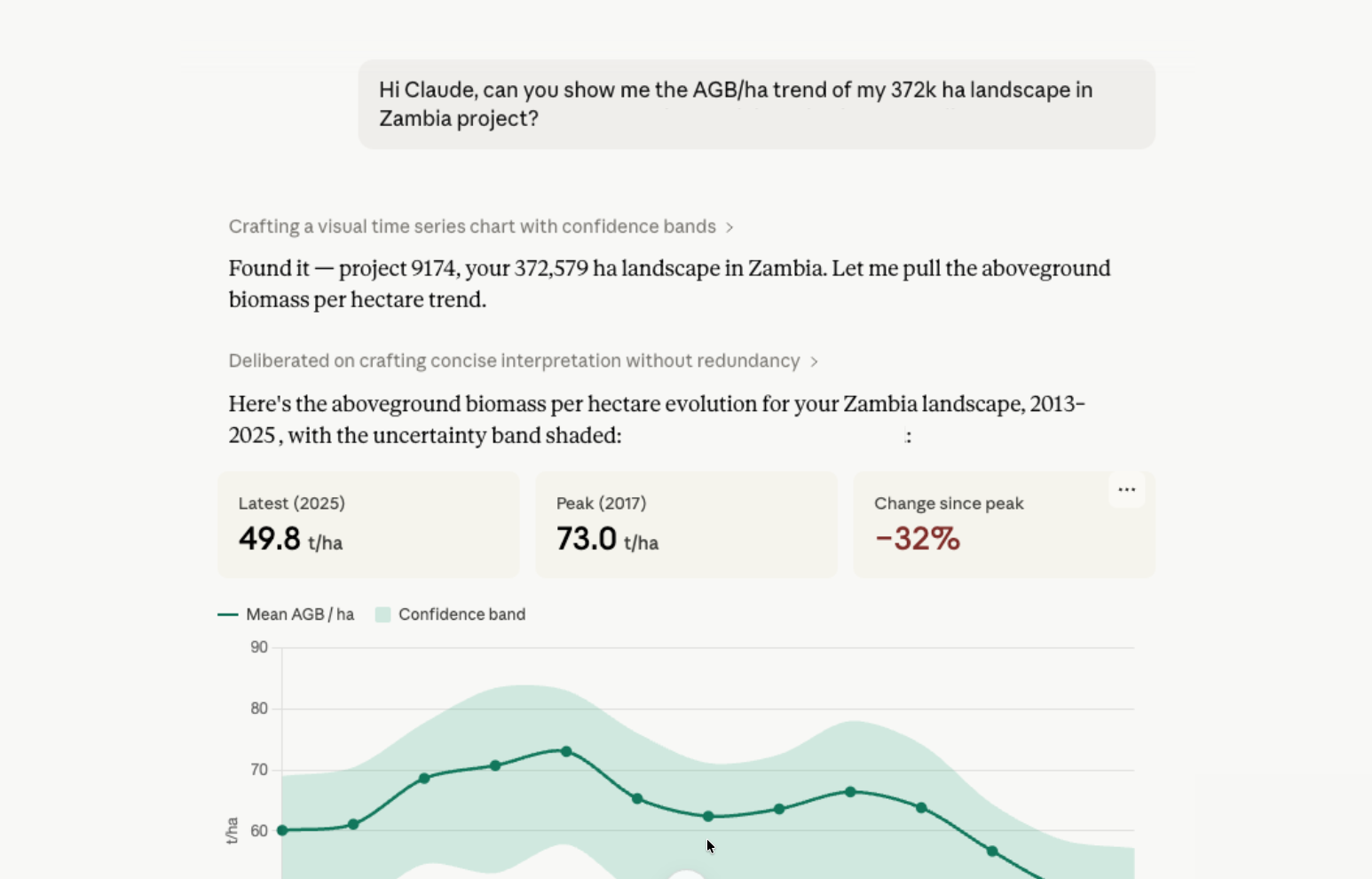
On resolution, our stocking index runs at 30 metres back to 2013 and at 10 metres from 2017, so historical matching reaches far enough back to satisfy the methodology's lookback while ongoing monitoring benefits from the finer product. On the correlation requirement, our index is aboveground biomass itself, measured in tonnes of dry matter per hectare, rather than a greenness proxy that has to be argued into a relationship with carbon stock. The model behind it has been validated against more than one million hectares of independent LiDAR-derived reference maps across 113 sites in temperate, tropical and mangrove ecosystems, drawn from six peer-reviewed publications.
Three practical things change.
Vetted outputs can be uploaded directly into the Verra Project Hub, which removes a reconciliation step from submission and review. We can also migrate our outputs into the Hub on your behalf if you would rather not handle it.
Selecting a provider becomes faster, which is the efficiency gain Verra is explicitly aiming at. You are choosing from a shortlist that has already been assessed against the methodology, instead of running that assessment yourself from scratch.
And conversations with your VVB start from firmer ground. A verifier reviewing a stocking index that Verra has already examined against VM0047's requirements is asking narrower questions than one encountering an unfamiliar data product for the first time. We expect that to compress validation timelines, though it is worth being precise about what the vetting does and does not do. Verra is clear that completing the process does not guarantee acceptance of any project, or approval of a provider's data for any specific project's stocking index. Projects and data are still independently reviewed by Verra and by a VVB. Developers can also use their own data, or a provider that is not on the list.
Since VM0047 was published we have delivered more than 30 dynamic baselines, across Latin America, Africa, Asia and Europe. What we have learned across those projects is that the data layer is necessary but not sufficient. Developers need the donor pool designed, the plots sampled and matched, the performance benchmark derived and documented, the sections written in the form the PDD template expects, and someone in the room when the VVB asks why a particular parameter was chosen. That is the work we do, and the vetting confirms the foundation it rests on.
Verra is the third registry to assess us, and the pattern is the point.
Isometric selected Kanop as an Earth observation data provider in February 2026, supporting certification under its Biosphere protocols for reforestation, improved forest management, mangroves and agroforestry. Equitable Earth selected us as one of two approved biomass data providers following benchmark testing against terrestrial and aerial LiDAR-derived reference datasets. Verra has now vetted us as a Data Service Provider for VM0047 dynamic baselines.
To our knowledge, Kanop is the only company independently vetted across all three of the registries that have run formal processes for nature-based data providers. Each assessment was run by a different organisation, against different criteria, with different reference data. For a developer weighing which standard to register under, that means the data foundation does not have to be rebuilt when the answer changes.
Verra is accepting Expressions of Interest from additional providers, and we expect the list to grow. That is a good thing. A market with several assessed providers is a healthier market than one with an accidental monopoly on credible data, and it puts the emphasis where it belongs, on the quality of the analysis rather than on the scarcity of the inputs.
Our own focus now is on the next layer of the problem. Baselines are increasingly well served. Forward projections are not, and they are what buyers underwrite when they sign an offtake years before a credit exists. We are working towards audit-grade carbon projections, starting with ARR.
If you are developing, financing or evaluating an ARR project under VM0047, or weighing which standard to register under, reach out at hello@kanop.io. Send us a boundary and we will tell you what we see.