Co-Founder & CEO

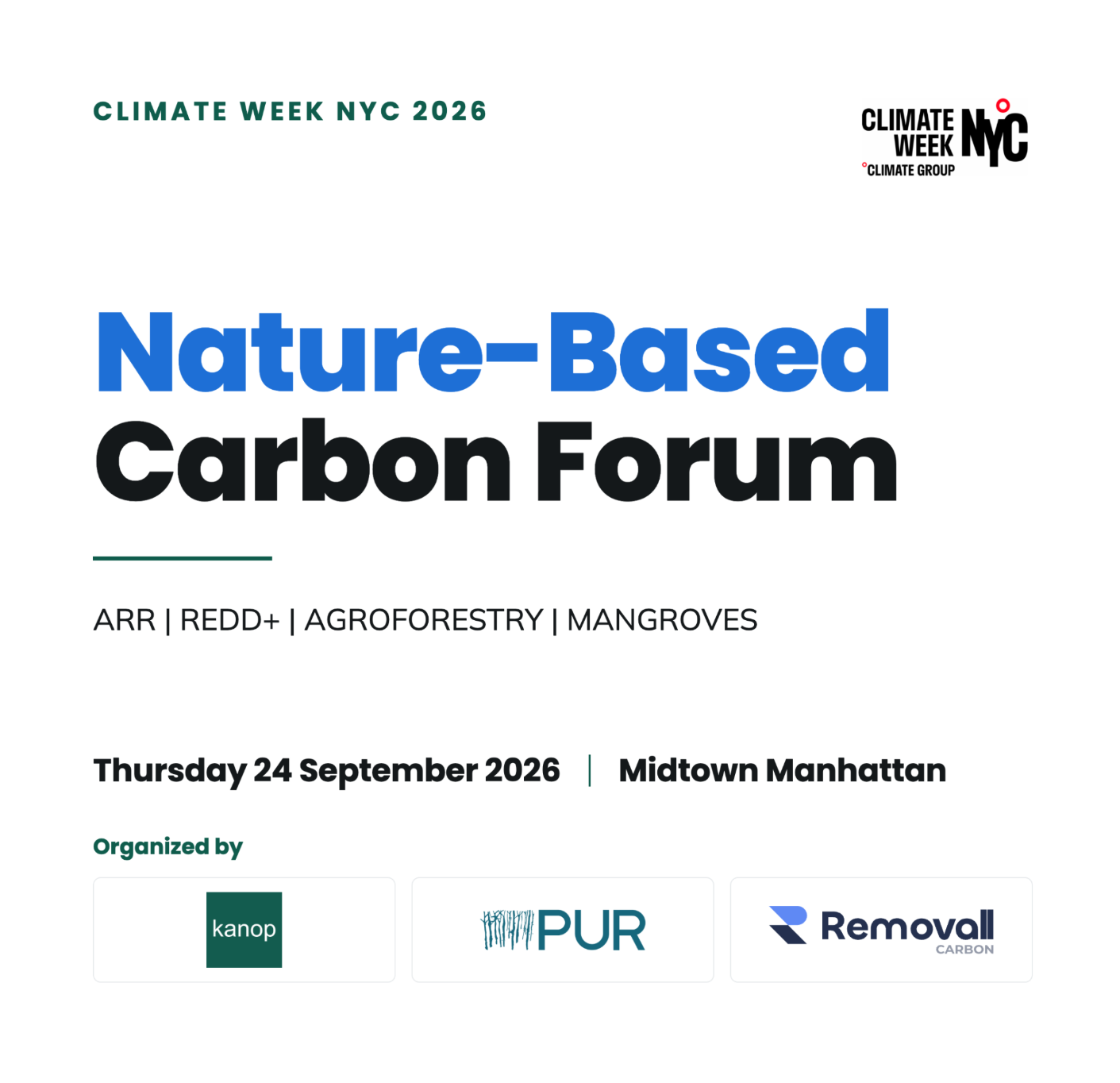
On Thursday 24 September, Kanop, PUR and Removall are hosting a full day on nature-based carbon at Jay Conference Bryant Park in Midtown Manhattan. Five sessions, four threads running through them (ARR, blue carbon, REDD+ and the capital that has to reach all three), and a deliberate preference for panels where people disagree. Here is what each session is really about, and why we think these are the questions worth a day of Climate Week.
Climate Week NYC produces a great many rooms, and most of them are broad by design. A little energy, a little policy, a little nature, several hundred people passing through. That format has its uses. It is not where the difficult questions in nature-based carbon get settled.
So we tried something different this year. Kanop, PUR and Removall pooled our networks and took a room for a full day, with one rule: nature-based solutions only. Restoration and conservation, the integrity and implementation questions underneath them, and the capital that has to reach both. It is not a single-vendor stage either. Each of the three of us hosts one session, and the people on them do not all agree.
The timing is what makes these questions live. Two things happened in this market over the past two months, and both are true at once. In August, Mombak issued 21,771 reforestation credits from its Amazon project, certified by Isometric against a dynamic baseline and delivered roughly two years ahead of the offtake schedule. That is the strongest evidence yet that a next-generation nature project can be measured, certified and delivered on a timetable a buyer can plan around. In the same period, BloombergNEF reported that Microsoft, which has accounted for close to half of all removal transactions this year, cut its purchasing by around 80% year on year. Supply is starting to prove it can deliver. Demand has become narrower and more demanding at exactly the same moment. Most of what follows sits in the gap between those two sentences.
The day opens at 9:20 with Margaret Morales of Carbon Capital Lab, and then goes straight into the first working session.
At 9:45, Kanop hosts a panel on ARR development, with Phil Cohn of Pollination, Megan Bomba of Component Earth and Jérôme Cochet of goodcarbon, moderated by our Head of Growth and Strategic Partnerships, Coby Strell. ARR is the pathway buyers say they want most, and yet issuance across the category has been broadly flat for four years. The quality spread inside it has become extreme: Sylvera’s H1 2026 data puts investment-grade ARR at an average of around $28.55 a credit against roughly $9.12 for the lowest-rated projects in the same category. So the question is not whether ARR works. It is what keeps slowing it down. Our own view, after supporting dynamic baselines across a few dozen projects, is that the measurement layer is no longer the binding constraint it was three years ago. Land tenure, nursery and planting capacity, the sequencing of pre-issuance capital and the willingness of buyers to contract before a single credit exists are now doing far more to set the pace. We would like to hear that challenged by people who structure the deals.
At 11:00, Removall hosts the blue carbon session, with Spencer Meyer of BeZero, Sarang Murthy of McKinsey & Company, Removall CEO Jérôme Beilin and Priya Sinha of CrossBoundary Group, moderated by Removall’s Chief Commercial Officer Jochen Gassner. Blue carbon is probably the most oversubscribed narrative in nature-based solutions and one of the least issued asset classes in it. The panel is built to walk the whole distance from project design to signed offtake, which means putting a rating agency, a buyer-side diligence team and an investor on the same stage. What evidence does a ratings methodology actually need from a mangrove system, where optical satellite data struggles and tidal dynamics complicate everything. What will a buyer commit to before issuance. What does a financeable structure look like when the revenue arrives late. These are not abstract questions for anyone with a coastal project in development.
At 13:00, PUR hosts the capital session, with Agustin Silvani of Bregal Sphere, Thomas Blackburn of SustainCERT, Vijnan Batchu of J.P. Morgan’s Center for Carbon Transition and PUR CEO Daniel Klier. The framing is deliberately uncomfortable: private investment into nature has genuinely scaled, and very little of it reaches early-stage project development. Forest Trends and The Nature Conservancy count $62.7 billion across nearly two thousand investments in their new assessment, while Carbon Direct estimates that nature-based removal finance needs to rise somewhere between 30% and 220% to meet the corporate targets already announced, against about $18 billion publicly committed since 2018. The gap is not awareness. It is that institutional capital needs instruments, track records and risk transfer that this asset class is only now starting to produce.
At 14:15 we look at REDD+, with Thibault Sorret of Equitable Earth, Julianne Baroody of Verra, Guy Turner of MSCI, Bruno Brazil of brCarbon and James Eaton of Climate Investment Partners. REDD+ has spent three years being rebuilt in public. The consolidated methodology arrived, and on 2 September the Integrity Council recognised VCS Version 5 as CCP-eligible, with VM0048 among the approved methodologies. That is real progress on the rules. It is not the same thing as restored buyer confidence, and satellite analyses published this month continue to find tree cover loss inside projects that are issuing credits. The honest version of this conversation asks whether the methodological reset is enough to bring buyers back into conservation at scale going into 2027, and what evidence would have to be on the table for that to happen.
David Antonioli closes the day at 15:15 on what happens after the carbon party, and specifically on endowments for implementation and permanence. It is the right note to end on, because permanence is being repriced right now rather than debated in the abstract. Verra has opened a durability pilot that lets projects use insurance or a fund-based approach in place of the pooled buffer account, and approved Artio’s reversal cover in August. Peer-reviewed work published in Nature this year found that buffer pools in the largest US forest carbon programme are too small for the climate risk they are carrying. And forecasters currently put the probability of a very strong El Niño this winter above 90%, with Amazon fire risk attached to it. A credit sold today implicitly promises decades of stewardship. Very few project structures fund those decades.
The room is built for the people who have to act on all of this: project developers, buyers and offtakers, investors and financiers, standards and rating agencies, and the advisors working across all of them. Coffee, lunch and genuinely long breaks are built in, because the conversations that start on stage are usually the ones worth finishing off it.
If you are in New York next week and working on nature-based carbon, come and argue with us. Attendance is by approval and places are limited. Register here